

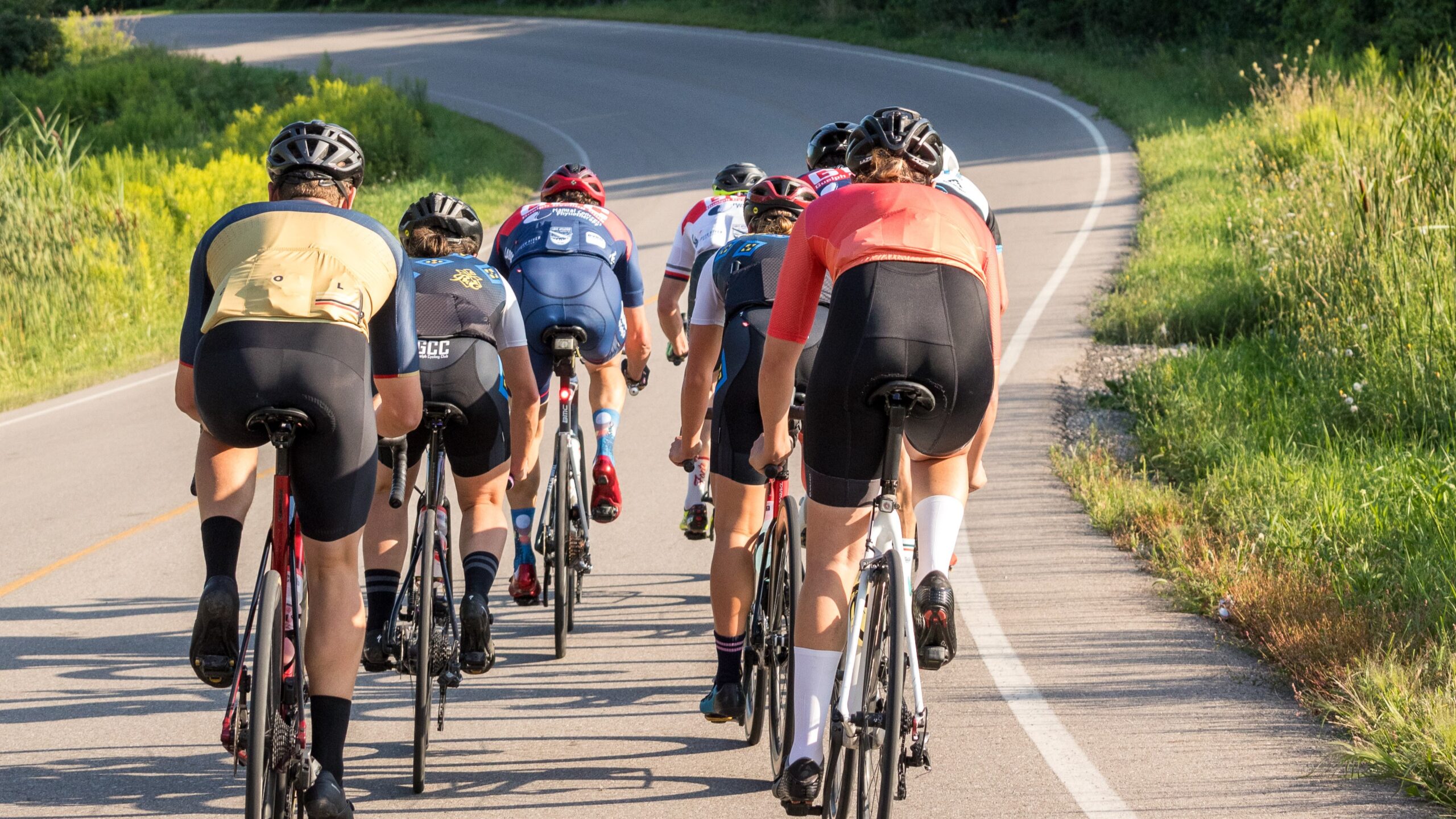
Constant Rotation is a great way to move riders of similar ability, at an efficient pace, utilizing a double paceline.
We typically reserve Constant Rotation for the R3 speed Group (34-36kph avg) on Tuesday evenings at the TAM Ride. Riders practice working together during the entire ride. We have adopted the Track Cycling name ‘Team Pursuit’ for this group, as they need to communicate and stay together to make this work well.
The simplest way to describe Constant Rotation is there are two pace lines side by side moving down the road at two different speeds. We typically run it with the left side line going slightly faster than the right side line. Both speeds are different from each other, but all riders are completely constant within their line with no surging. Think of it as a slightly faster speed group in a single line passing a slightly slower speed group in a single line. Fast line on the left and slower line on the right.
As the faster line overtakes the slower one, riders transition between groups: a rider from the front of the faster line moves to the right to join the slower line, while a rider from the back of the slower line moves to the left to join the faster line. This continuous exchange, without any pause at the front or back, establishes the constant rotation, similar to a social paceline but with uninterrupted flow.
Ideally, each full rotation involves just one acceleration and one deceleration. When moving from the back of the right line to the left, riders gently accelerate to match the left line’s slightly higher speed. Conversely, the trickiest part is when the lead rider in the left line moves to the front of the right line; they must gently decelerate to match the slower pace of the right line. To learn this “speed matching”, it requires verbal communication from the following rider on the right and and 360-degree awareness from all riders, underscoring the “Team” in Team Pursuit. Everyone needs to talk and be willing to receive input. We’ve successfully taught this technique for years.
The rider at the front of the right side receiving a decelerating rider must be willing to help them understand how much to back off (or speed up) to speed match perfectly. After a while, it becomes ingrained and riders know instinctively how much, or how little, to decelerate and don’t need to be told anymore. In time, little or no talking is necessary as riders become more skilled.
As all of this continues, the double paceline appears to be rotating as the group rides down the road. It gets quite easy with practice.
Constant Rotation is really great to be a part of when everyone is working well together. Just ask any of the regular R3 riders!
Typical problems:
- Insufficient Deceleration to the Right Line: If a rider doesn’t slow enough when moving to the right line, it creates a gap.
- Resist the urge to accelerate to close it; maintain the line’s constant speed. The next rider from the left can slot in, or the offending rider will correct their pace. Often, simply letting the ‘gap’ exist sends the clearest message.
- Premature Acceleration in the Left Line: The second rider in the left line accelerates once the rider in front of them moves from the left side to the right.
- This usually creates a gap on the left line and often the tendency for the rider behind is to ‘chase’ or surge – a common, but incorrect, reaction. Never chase a surging rider. Instead, maintain the left line’s constant speed and continue the rotation. Remind the rider to hold a steady pace. Remember, the only acceleration occurs at the back of the line, never the front.